AI Transformation
We've run machine learning in production since before it was a buzzword, and we help organizations put it to work with the data and teams they already have.
Happy Cog is a full-service digital agency, so the people who plan your AI work also design the interface, build the integrations, and measure whether it paid off. That covers knowledge systems and chatbots, custom MCP servers that give AI models controlled access to your data, agentic workflows for internal operations, and the search and media work that decides whether AI assistants recommend your brand. You can hire us for all of it or for one piece, and plenty of our clients start with a single use case.
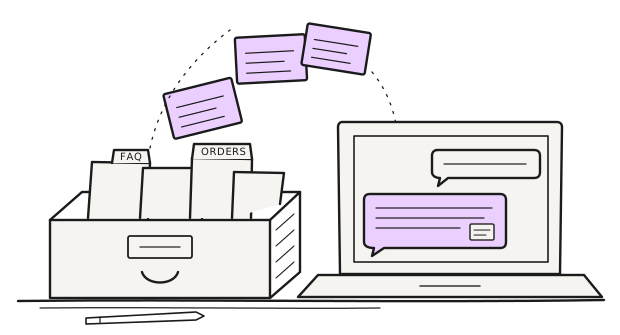
Thirteen years of running AI where the results get measured.
Our paid media technology has made live bid and budget decisions since 2013, adjusting as often as every thirty minutes across every major ad platform.
Strategists, designers, engineers, analysts, and marketers who scope AI work together, so data and measurement questions come up in discovery.
That's how many requests the AI agents we've built and manage handle every day, for clients and for our own team.
-
1999Founded
-
2013Machine learning in live media buying
-
2024Our first RAG assistant for a client goes live in production
-
2025Fine-tuned models and semantic search for clients
-
2026Custom MCP servers and agentic commerce
We came out of the web standards movement, which taught us to build for systems that didn't exist yet. That habit is why we had machine learning buying media in 2013 and why our engineers are building MCP servers for clients now. It has also made us careful about where AI belongs, because we've seen the same tool save a team hours and then invent an answer it had no basis for.
Selected clients














Three things tend to stall an AI program, and we've been brought in to fix each of them.
The pilot worked in the demo and never reached a customer.
Most organizations we talk to have run a proof of concept, and far fewer have anything in production that a customer or employee depends on. The model is rarely the problem. What's missing is usually clean data the system can reach, a plan for when it answers wrong, and someone who owns it after launch.
Your data isn't in a shape any model can use.
Product details live in one system, policies live in PDFs, order history lives somewhere else, and nothing connects them. An assistant built on top of that will answer confidently and incorrectly. We usually spend the first phase of an engagement consolidating and structuring the sources the AI will draw from, because that work decides how accurate everything after it can be.
AI assistants are describing your brand, and nobody is checking what they say.
ChatGPT, Perplexity, Gemini, Claude, and Google's AI Overviews now answer questions your customers used to type into a search box. Most brands have no reporting on whether they're cited, how they're described, or how much traffic those answers send. In one direct-to-consumer account we manage, referrals from AI assistants grew about 22 percent half over half while still making up under one percent of sessions, and that's why we measure them now.
Our AI work covers six areas, and you can bring us in for one of them.
We scope and price each area on its own. Most engagements draw on two or three.
01 AI strategy and readiness Where AI belongs in your operation, what it needs, and what could go wrong. +
Our strategy team interviews the people who own the outcome and the people who do the work today, then ranks candidate use cases by data availability, risk, and expected return. You get the ranked list with the trade-offs written down, a governance plan that says who reviews what, and a roadmap you can fund one phase at a time. Some use cases come back as "not yet," usually because the data isn't ready or a wrong answer would cost too much, and we'll tell you which ones. In regulated categories, we'll recommend keeping a person in the loop on any decision that could go against a customer.
02 Data, knowledge, and search Consolidating what you know so a model can use it accurately. +
Our engineers build pipelines that ingest and normalize internal data (product catalogs, policies, support history, and operational databases), then connect it to models through retrieval-augmented generation, or RAG, a method where the AI looks up current facts from your own sources before it answers. We've fine-tuned custom models on client data using hosted models from OpenAI and Anthropic, and open-source models such as Meta's Llama running on infrastructure the client controls. The same foundation powers AI-assisted semantic search on a public website and lets employees ask plain-English questions about internal data, including flagging anomalies in an operations data warehouse.
03 Custom MCP servers and agentic commerce Giving AI agents controlled, structured access to your systems. +
Model Context Protocol (MCP) is the open standard that lets AI assistants such as Claude and ChatGPT connect to outside systems and take actions in them. Our engineers build custom MCP servers that expose a client's data and functions to internal agents, partner systems, and public AI assistants, with credentials stored on the server so a model never sees them. For one large industrial client, we built MCP tools that let an AI agent look up products, manage a cart, and complete checkout, and we're now extending that catalog to public pages so crawlers and assistants can find the products too.
04 Agentic workflows and internal automation Handing repetitive, high-volume work to AI agents under human review. +
Our team builds agents for internal work that's slow or hard to do consistently, such as reconciling reports, auditing content, generating tests, and processing batches of records overnight. One of our Senior Engineering Managers built a batch framework called Nightshift when a client's move to WordPress VIP needed hundreds of legacy components rebuilt in a couple of weeks. It splits that kind of work across specialized sub-agents that refine their own instructions as they go. We've also trained our own finance team to build agents that work with their spreadsheets and files, and we offer the same training to client teams.
05 Conversational experiences Assistants and chatbots connected to the systems behind them. +
We build customer-facing and employee-facing assistants that connect to live data, so they can answer specific questions and take action. For one large fast casual restaurant chain, our developers built an assistant on OpenAI's API with RAG over the company's knowledge base. It filters out spam, answers questions about hours, menus, and ingredient calories across more than 70 locations, handles refunds and loyalty points, and routes anything it shouldn't handle to a representative. We design the conversation, the handoff rules, and the analytics together, since an assistant nobody can measure is hard to improve.
06 AI-ready design, content, and CMS Sites and publishing tools built for people and for the models reading them. +
AI systems now read and summarize websites alongside human visitors, so our designers and engineers build the semantic, accessible structure (strict heading hierarchy, schema markup, and clean component logic) that lets a model interpret and cite a page. We also connect content management systems to AI assistants, so your team can draft and assemble pages from Claude or ChatGPT without logging into the CMS, with approval steps that keep anything from publishing until an editor signs off. Our engineers maintain tooling that lets AI agents work directly with Craft CMS content and structure.
Runs through all six
AI visibility and media
Our SEO team tracks how often AI assistants cite your brand, how they describe you, and how much traffic they send, then works on content structure, crawler access, and off-site reputation so you're easier to recommend. Our paid media team brings the same discipline to Google's AI Max and Meta's Advantage+ campaigns. We use the automation where it lowers cost per acquisition, review platform recommendations before applying them, and keep brand and non-brand spend separate. Every ad account stays in your name.
Runs through all six
Measurement and governance
Our analytics team instruments AI features like any other product, tracking conversation outcomes, escalations, and conversions, and separating bot traffic from real visitors so the reports stay accurate. When one client's corporate site showed a traffic spike during chatbot testing, our analysts traced it to the bot's own crawling and set up filters to keep it out of GA4. Governance covers who reviews AI output, what gets logged, and how we roll a system back if something goes wrong.
Here's how an AI engagement runs.
We won't start building until we know which data the system will draw on and who's accountable for its answers.
-
Phase 01
Use-case discovery
Our strategy lead interviews the people who own the outcome and the people who'd use the system, then runs a workshop to rank candidate use cases by value, feasibility, and risk.
-
Phase 02
Data and governance readiness
Our engineers audit the sources the AI will depend on, including access, quality, and privacy constraints. We write the review rules, escalation paths, and logging requirements with your team before anything gets built.
-
Phase 03
Build and test against real data
We build the first version connected to your actual data and test it with the people who'll use it. Before launch, we score its answers against a set of real questions with known correct answers, so accuracy is a number you can see.
-
Phase 04
Launch with guardrails
We release to a limited audience first, with a person reviewing output and a rollback plan written in advance.
-
Phase 05
Measure and expand
Our analytics team tracks the metric we agreed on at the start. Once the first use case is performing, we decide with you which one comes next.
Each phase is scoped and priced on its own, and you can stop after any of them.
We put AI to work across our own agency before we recommended it to anyone else.
Our paid media technology has made live bid and budget decisions since 2013. Today our team runs AI across daily operations: we've built dozens of custom MCP servers that connect our AI tools to the major ad platforms, our project management system, and our finance data, and our marketing team uses AI skills that assemble client briefings from more than ten sources.
That experience is where our caution comes from. We've seen where these tools save hours and where they get things wrong with total confidence, and we build client systems with both in mind.
Everything we build is yours to use. You own your data, your models, your prompts, and your accounts. A person on our team reviews anything customer-facing before it ships, and when AI isn't the right answer for a problem, we'll say so.

Questions we get asked before an AI engagement starts.
What does AI transformation mean at Happy Cog?+
It means putting AI into the systems your customers and employees use, with the data, governance, and measurement it needs to stay accurate. Sometimes that's a customer service assistant, sometimes it's an internal agent that processes records overnight, and sometimes it's restructuring your site so AI search tools describe you correctly. We start with the business problem and choose the technology after.
Where should we start?+
Start with one use case where the data exists, the value is measurable, and a wrong answer is recoverable. Customer support, internal knowledge search, and content operations are common first projects. Our discovery phase ranks your candidates, so you're choosing based on evidence.
Does our data need to be clean before we start?+
Not at all. We'll work with you to get it reachable and reliable enough to build on.
Which AI models do you work with?+
We work with hosted models from OpenAI and Anthropic and with open-source models such as Meta's Llama, including models that run on your own infrastructure when data can't go to a third party. We choose based on accuracy for your task, cost per request, and your security requirements, and we design systems so the model can be swapped later.
How do you handle privacy and security?+
We keep credentials on the server and out of any model's reach, give agents only the permissions a task needs, and log what they do. For sensitive data we can run models on infrastructure you control. We'll work within your legal and security review and document the data flows for it.
What is an MCP server, and do we need one?+
MCP, or Model Context Protocol, is the open standard that lets AI assistants connect to outside systems. You need one when you want AI agents (your own, a partner's, or a public assistant like ChatGPT) to read your data or take actions such as placing an order. Many organizations don't need one yet, and we'll tell you if you're one of them.
How long does it take?+
We know how important this kind of work is for your strategy. Every project is different, but we commit to moving with a sense of urgency, and giving you actionable and reviewable work quickly.
How do you measure whether it worked?+
We'll work with you to agree on the KPIs before we build anything. For a support assistant that could be resolution rate and cost per conversation; for an internal workflow, hours saved; for AI search visibility, citations and referral traffic from AI assistants. Then our analytics team instruments those, so the results show up in your reporting.
Can you help our brand show up in ChatGPT and Google's AI Overviews?+
Yes. We specialize in that through our dedicated SEO and AEO team. We start by measuring where you're cited today, then fix technical access (including whether AI crawlers such as GPTBot and ClaudeBot can reach your content), structure content so it can be quoted, and build off-site authority.
AI work usually connects to something more specific.
By industry
Services this connects to
Platforms we build on
Related reading
- Introducing Nightshift: A Batch Processing Framework for AI Agents
- When 2500+ Pages Need Summaries: Automating Content Previews with Local AI
- SEO Is No Longer Enough: Why Your Brand Needs to Be Optimized for AI, Too
- What ChatGPT's May 2026 Update Means for Your Brand's Website Traffic
- &pizza AI Chatbot (case study)
If you're working out where AI fits, tell us what you'd like it to fix.
Whether that's a pilot that stalled, a support queue that keeps growing, or a question about whether AI is worth the investment for you at all, we'd like to hear it. We'll tell you what we'd do about it and what it would take, and if we're not the right people for it, we'll say so.

Tell us what you'd like AI to do.