Higher Education · A Happy Cog vertical
Design, development, and enrollment marketing for colleges and universities.
Happy Cog is a full-service higher education digital agency, and our education practice covers more ground than most institutions expect from one firm. We’ve redesigned academic sites and admissions experiences, built design systems that in-house web teams still run years later, and managed program-level paid media across dozens of degrees at a time. We’ve also built the analytics that connects an enrolled student back to the ad that first reached her, which is the part almost nobody else does.
We do design, development, and digital marketing in one senior team, and the people you meet in the first conversation are the people who do the work.
We’ll reply within one business day. No sales sequence, no spam.
+140%
Growth in graduate applications
At a private Northeast university, during a fiscal year in which our team rebuilt its campaign structure school by school. Its strongest year on record.
34%
Applications that became students
Share of the applications we influenced or generated that turned into enrolled students, measured against the university’s own records.
−33%
Cost per application
Year over year at the same institution, across more than five thousand applications.
Institutions that trusted us with the work.





Ivy League and R1 research universities, small liberal arts colleges, and regional privates. We’ve worked with central marketing teams, individual schools and colleges, admissions offices, and advancement.
The problems we solve
Three problems keep showing up, whatever the institution’s size.
None of them is solved by a redesign alone, a new CRM, or a bigger media budget, so we built a practice that works across all three.
01
One institution, eight audiences, one website
A seventeen-year-old at eleven at night, a parent looking at the bill, and a trustee are all on the same page.
A university site has to serve prospective first-years, transfers, graduate and professional applicants, international students, parents, current students, faculty, alumni, and donors. Most of them arrive through search or an AI answer rather than the homepage, and dozens of departments own their own pages. The predictable result is a site organized around the org chart instead of around what someone is trying to find out. We start by talking to the actual audiences, then build an information architecture and component system around the decisions people are making, so a decentralized team can publish without degrading the experience.
02
Dozens of programs, dozens of funnels, one budget
Every dean wants to know how their programs are doing, and they’re right to ask.
An MBA, an accelerated nursing degree, an MFA in creative writing, and a new master’s in machine learning share almost nothing. They have different competitors, different search demand, different seasonality, and a different person on campus asking about them. A single consolidated account cannot serve that, which is why we structure programs individually and report at the school level. At one private university we run campaigns broken out by school and by degree across search, Performance Max, programmatic, CTV, paid social, LinkedIn, and out-of-home, and we build separate data packages for individual deans’ meetings. That structure is what lets us move budget toward the programs where another dollar actually produces an application.
03
Marketing is measured on inquiries and judged on enrollment
Platform automation will happily buy you a pile of applicants who never show up in September.
Inquiries and applications are easy to count and weak as optimization targets. Enrollment is the number the president cares about, and it happens weeks or months after the click, inside a system the ad platforms cannot see. Closing that gap is an engineering problem more than a media one, and it is the one we have spent the most time on in this vertical.
Recognize one of these? Tell us what you’re solving for ↓
Design
Design for a university is a consensus problem before it’s a visual one.
Our design practice draws on the work of design anthropologist Dori Tunstall, whose idea of respectful design holds that a designer’s expertise should support community-led solutions rather than impose expert order. On a campus that isn’t a philosophical nicety. It’s the only approach that survives a faculty senate, a cabinet review, and a dean who has opinions about typography. We design with you rather than for you, we work in open batches rather than staging a big reveal, and we bring people into the room while the work can still change. On a recent liberal arts college redesign, the students who give campus tours reviewed the designs, and faculty and academic leadership joined working sessions on how the academic story should be told.
We design with the committee, not around it
Our designers run the work in rolling batches with review built into each one, so nothing arrives as a surprise and consensus accumulates instead of getting forced at the end. We make the reasoning behind each decision visible, which matters when the person who has to defend the homepage internally isn’t the person who commissioned it.
Program pages are your highest-intent pages and usually your most neglected
A prospective student who reaches a program page is further along than any other visitor on the site, and that page is often the one nobody has touched in four years. We design a program template system that a department coordinator can populate without a designer, holding curriculum, outcomes, faculty, cost, and the application path in a consistent structure that search engines and AI tools can read.
An academic model that resists templates deserves a design that doesn’t flatten it
What makes an institution distinctive is usually the thing a generic higher ed template erases first. A college built on individualized study, one-on-one faculty conferences, and interdisciplinary work needs an experience that expresses that, and a research university with sixteen schools needs something else entirely. We treat content, structure, and design as one thing people experience together rather than three deliverables that meet at the end.
Design your team can carry forward without us
We document the system, hand over the components, and train the people who’ll use them. Our aim is to make your team more self-sufficient rather than more dependent on an agency, and several of the design systems we’ve built for universities are still being extended in-house years after launch. Harvard Business School was a flexible design system with the tools to maintain it, and Gettysburg’s visual language came out of the college’s own mid-century printed materials rather than a trend we brought with us.
The enrollment loop
An enrolled student is the only number that matters, and it happens where the ad platforms can’t see it.
Here is the problem in one sentence. Your ad platforms optimize toward whatever you report back to them, and if all you can report is a form fill, they will get very good at producing form fills from people who were never going to enroll. Fixing that means getting enrollment outcomes out of Slate and back into the platforms, which is plumbing, not strategy, and it’s the work we’ve done most often in this vertical.
At one private college we built a system that passes unique student identifiers from Slate back into paid media conversion tracking, so enrollments tie directly to the digital activity that produced them. At a private university we’re running daily automated audience syncs from Slate into Google, Meta, and Yahoo DSP alongside offline conversion import via GCLID, so bidding optimizes toward applicants who enroll rather than inquiries that are merely cheap. On that account, 34% of the applications we influenced or generated became enrolled students, measured against the university’s own records rather than a platform’s estimate.
The rest of the measurement work supports the same goal. Our analytics engineers implement GA4 and GTM with cross-domain tracking into third-party application platforms, integrate call tracking so phone inquiries tie back to campaigns, and build attribution that separates the channels introducing students from the ones influencing and closing them, because last-touch reporting in higher ed credits your own brand search for everything.
Slate, the SIS, and the ad platforms
Connected, so enrollment outcomes reach the systems making bid decisions.
Enrolled students
The optimization target, rather than inquiries or applications.
0 black boxes
Your enrollment office, your deans, and your CFO see the same numbers we do.
Development
Most universities have a web team and a CMS they didn’t ask our opinion about. We build for that reality.
A lot of agencies treat an institution’s in-house developers as an obstacle. We treat them as the client, because they’re the ones who’ll own the site long after we’ve gone. At Gettysburg our developers built responsive front-end templates and a system of reusable code and handed it to the Gettysburg team to integrate with their CMS. At a recent liberal arts college redesign we designed the site and their team built it. Both models work when the handoff is designed rather than improvised.
ADA Title II and WCAG 2.1 AA
Public institutions now have a compliance obligation with a date attached, and accessibility has been part of our practice since long before the rule existed. Our designers work to an accessibility checklist from the concept stage rather than retrofitting at QA, covering keyboard navigation and focus states, screen reader behavior, color contrast, semantic heading structure, alt text, and motion that never carries meaning on its own. We can work an existing site toward compliance on a deadline, and we can train your content team so it stays that way.
The platforms higher ed actually runs on
Our developers work in Craft, WordPress, Sanity, Laravel, and headless architectures with React and Next.js front ends. We’re a WordPress VIP Premier Partner and a Craft Verified Partner, and we’ve maintained platforms for more than a decade in some cases. We recommend the technology that fits your team and your governance model rather than the one we’d enjoy building.
Integrations that exist on a campus and nowhere else
Slate, the student information system, event and open-house registration, program finders, course catalogs, and the giving stack. We’ve built cross-domain tracking into third-party application platforms and passed identifiers between Slate and the ad platforms, so we know where these systems are difficult before we start.
AI in the build, with engineers governing it
AI-assisted development is compressing our build and QA cycles, and it moves our engineers’ attention toward architecture, security, and performance, which is the part that keeps speed from turning into risk. Our team also uses AI to reason through features before building them and to run self-testing agents against the work.
Performance marketing
A better website doesn’t fill a class. The media program does that.
Our digital marketing practice rests on paid media, organic and AI search, and analytics, and in higher ed the three are inseparable, because a program page is simultaneously a paid landing page, an organic ranking asset, and a source an AI tool will cite. We start from your enrollment goals by program rather than from a channel plan, and we build the account to serve them.
Paid search and Performance Max, structured by school and program
At one private college we built more than 250 granular campaigns broken out by campus with tight keyword-to-ad structure, which raised quality scores and pulled costs down. At a private university we structure by school and degree, support new program launches with keyword research and copy from scratch, and run program audits on a rolling basis. Brand and non-brand stay separated, because a university’s own name will otherwise absorb the credit for everything.
Programmatic, CTV, OLV, and out-of-home
We hold seats on the major DSPs, including The Trade Desk, Yahoo DSP, Simpli.fi, Illumin, MNTN, and DV360, and we invoice spend directly so you skip a licensing fee per platform. In higher ed this carries the awareness work that search gets credit for: geo-targeted campaigns around a new campus location, open-house promotion, CTV and online video with completion rates we hold ourselves to, and audience targeting narrow enough to reach the right few thousand people for a small graduate program.
Paid social and LinkedIn for graduate recruitment
LinkedIn earns its place for graduate, professional, and executive programs in a way it rarely does for undergraduate recruitment, and we’ve run document ads and lead-generation forms against working professionals considering a return to school. Meta carries a different job, closer to home for undergraduate and regional awareness. We judge each on contribution to applications rather than on platform-reported cost per lead.
SEO for a site with fifteen thousand pages
A university site is usually the largest and least governed property we’re asked to work on. Our SEO team prioritizes the pages that carry the most weight (admissions, financial aid, tuition, transfer, and program pages), then works through title tags, metadata, internal linking, and content structure at scale. At one university this produced a 57% increase in page-one organic rankings, and at another we’ve held an annual SEO retainer that has renewed every year for the better part of a decade.
Reporting your deans will actually read
Weekly performance reporting, monthly strategy reviews, and school-level data packages built for the meeting they’re going into. Our Premier Partner status with the major ad networks gets clients early access to alphas and betas, and we hold back a small share of budget for disciplined testing that feeds the evergreen program.
Ready to talk media? Jump to the form ↓
AI search
Your next applicant may ask an assistant about tuition before she ever opens your website.
Prospective students and their parents are asking AI tools what a degree costs, whether credits transfer, what the aid package looks like, and what the admissions requirements are. The answer gets assembled from whatever those systems can find and trust, which creates a kind of exposure institutions haven’t had to manage before. The answer can be out of date, it can be incomplete, or it can be about a different school entirely.
We measured this rather than assuming it. For a college that shares its name with several other institutions, our team ran a structured study across ChatGPT, Gemini, and Perplexity on the questions prospective students actually ask, logging for every prompt which institution the answer described and which pages the tool cited. Asked plainly about the college by name, these tools routinely answered about a similarly named university in another state, and in one case about an institution on another continent. On unbranded questions about the cost of a private university in its own region, the college didn’t appear at all.
That work turned into a remediation program, and it’s the shape of what we’d do for you: establishing the institution as a distinct entity that these systems can tell apart from its namesakes, getting structured data and consistent naming in place, and rewriting the specific admissions and aid pages the tools were already citing so that the answer they produce is the one you’d want given. Where an admissions subdomain is outside your control, we work out how to keep it from being the page that carries the answer.
We instrument AI-referred traffic now, while the volume is still small, because the trajectory is the reason to start early rather than after it matters.
AI in production since 2013
We’ve been running AI in paid media since 2013. The rest of our practice caught up.
When the industry started calling AI a marketing differentiator, our paid media team had been running it in production for over a decade. That isn’t a positioning claim. It’s the year we integrated machine learning into bid and budget management, and our proprietary system still moves money across channels as often as every 30 minutes, calibrated against your enrollment economics rather than platform defaults. In a program-level account that matters more than usual, because the right bid for a doctoral program with nine searches a month has nothing in common with the right bid for undergraduate business.
Today AI runs through every discipline we practice. Our engineers reason through features with it before building them, our media team’s optimization runs continuously, our designers test experiences against real behavior, and our SEO team uses it to work a fifteen-thousand-page site at a pace a human team couldn’t. The People First part is deliberate. Our clients aren’t hiring an AI vendor. They’re hiring a senior, opinionated team that uses AI to do more, faster, with better judgment. The human expertise is the difference. AI is the multiplier.
2013
AI in paid media
The year we integrated machine learning into bid and budget management.
30 min
Optimization cadence
How often our system reacts to live auction behavior across every channel.
0
Black boxes
Every decision our system makes is visible. You see what we see.
One team
Designers who understand the enrollment funnel. Engineers who’ve worked inside Slate. One team.
Design
Development
Marketing
Analytics
When design, development, and marketing are the same team, the problems that fall between them stop falling. The paid search campaign lands on a program page the same people designed, the GA4 implementation measuring it was built by the people running it, and the Slate integration reporting enrollment feeds the audiences that sharpen the media. Your accessibility work and your SEO work stop competing for the same page, because semantic structure serves both.
We don’t outsource any of it, and the senior people you meet first are the ones doing the work. For an institution running a redesign, a compliance deadline, and a recruitment cycle at the same time, that integration is usually the difference between three vendors pointing at each other and one team with a plan.
Selected work
The same practice, at work on real institutions.
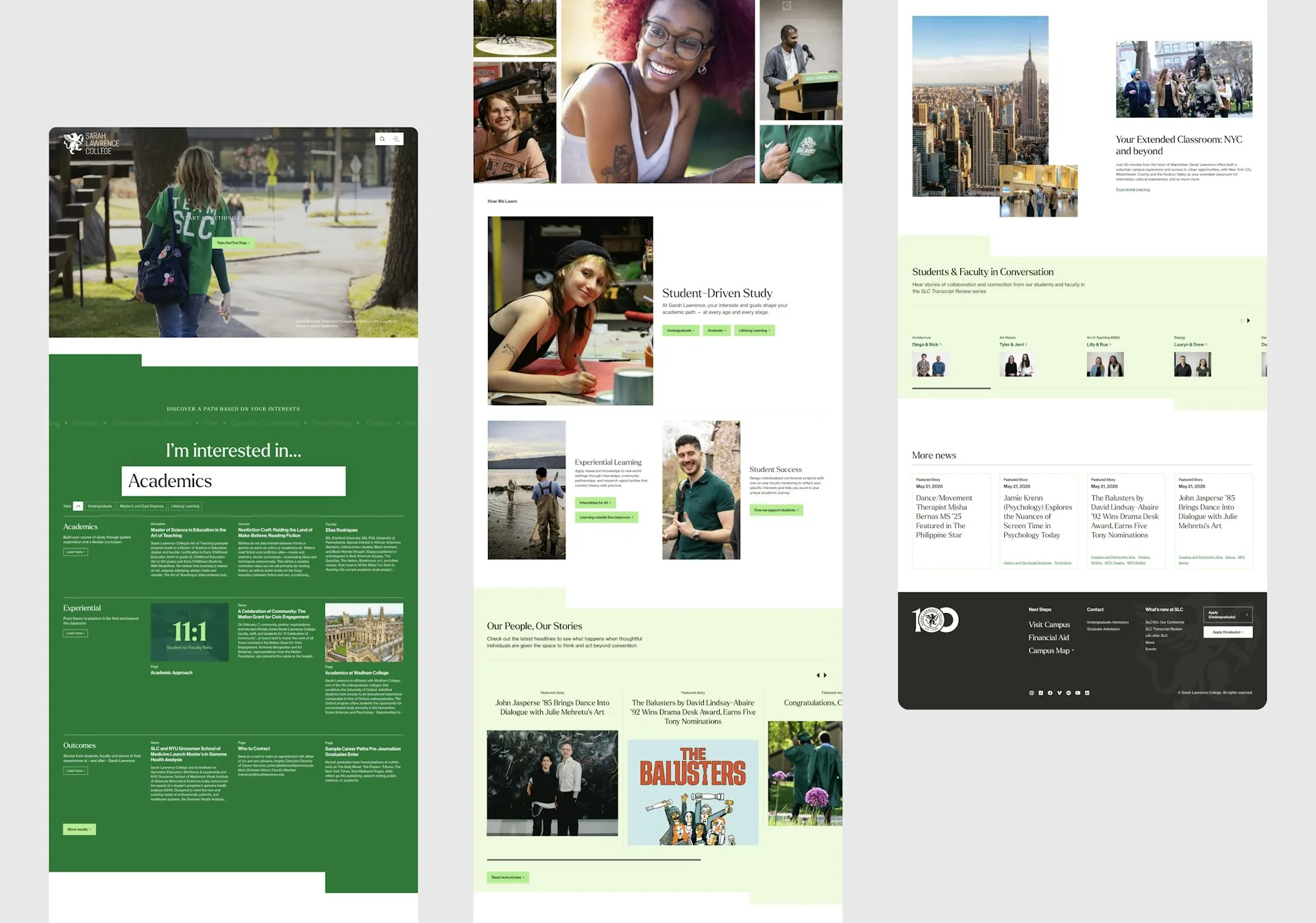
Sarah Lawrence College
A higher ed website beyond convention. We designed a site for a college built on individualized study and interdisciplinary work, an academic model a conventional template would have flattened. The college’s own team developed and launched it.
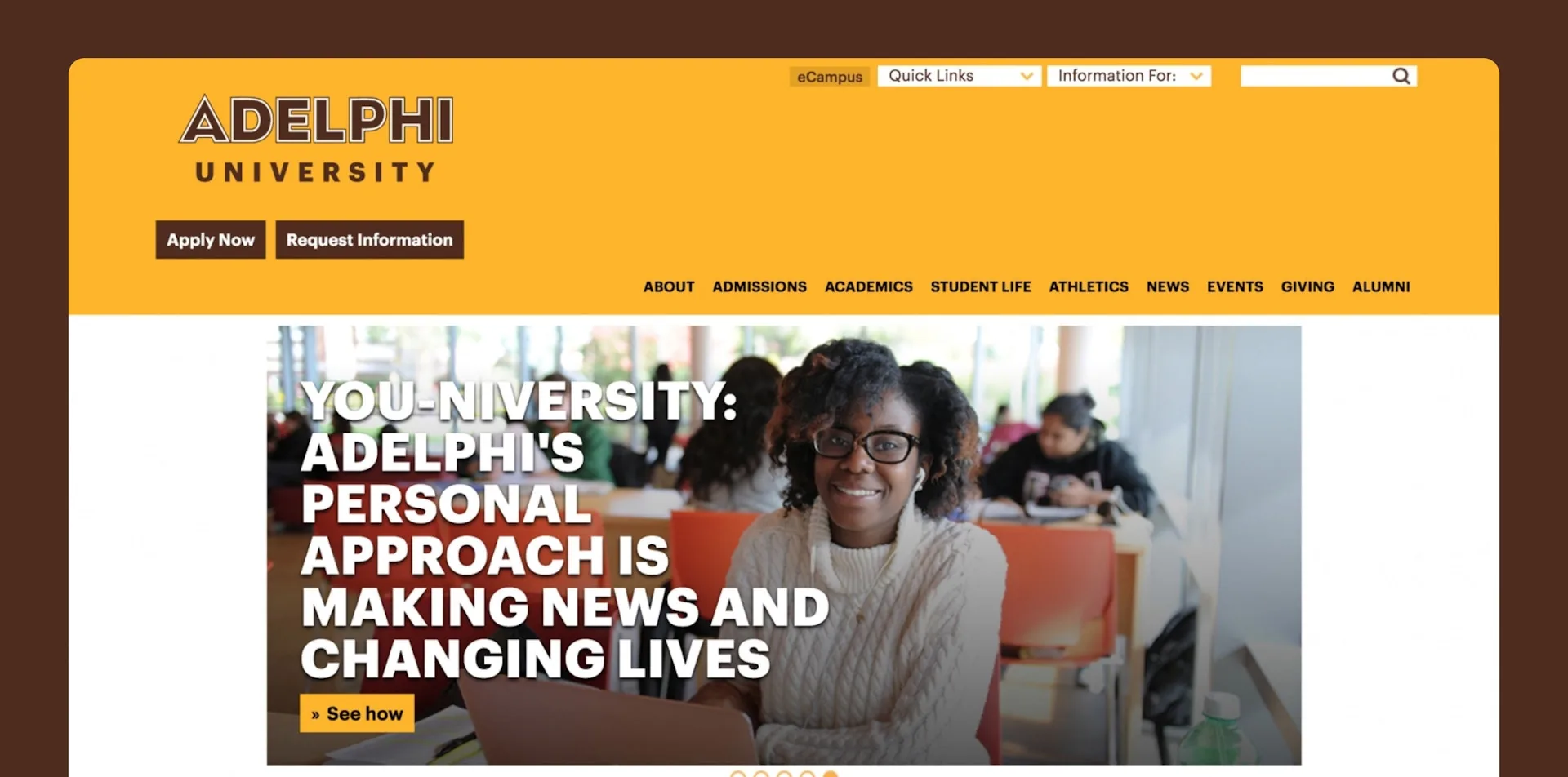
Adelphi University
A multi-year digital marketing partnership running program-level campaigns across search, programmatic, paid social, and out-of-home, with analytics that ties applications back to enrollment.
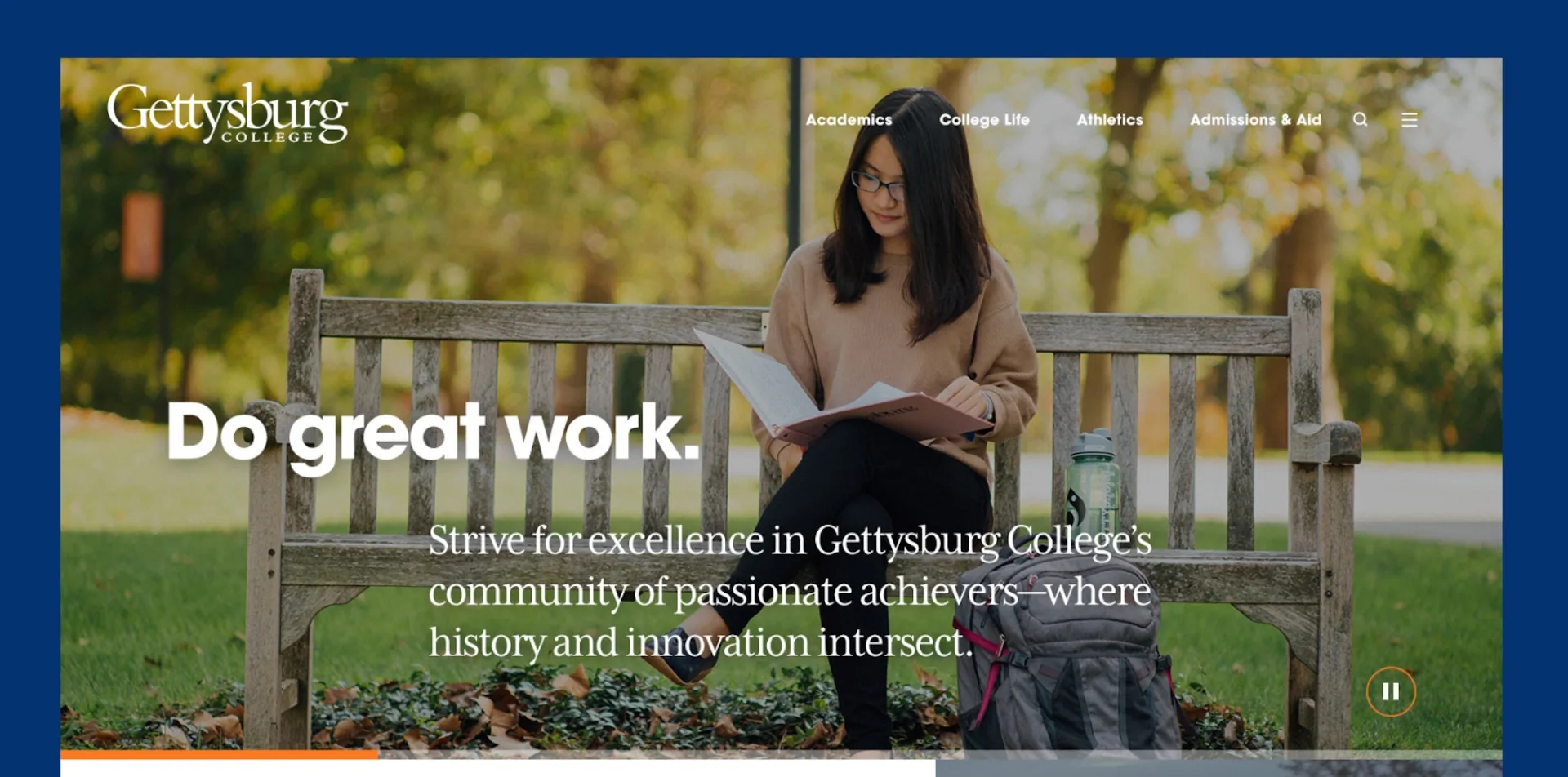
Gettysburg College
A People-First approach to academic search, including a reusable front-end system built for the college’s in-house team to own and extend.
Want work like this at your institution? Start a conversation ↓
Running marketing or digital at a college or university? We’d like to hear what you’re solving for.
Maybe you’re planning a redesign, working against a Title II accessibility deadline, restructuring paid media before the next recruitment cycle, trying to close the gap between inquiries and enrolled students, or working out what AI search means for your admissions pages. Start with a 30-minute conversation with the people who’d do the work, not a sales team.
Tell us what you’re solving for.
We’ll reply within one business day. No sales sequence, no spam.