services

Law A Happy Cog vertical

Happy Cog designs, builds, and markets for law firms, from global practices to trial boutiques.

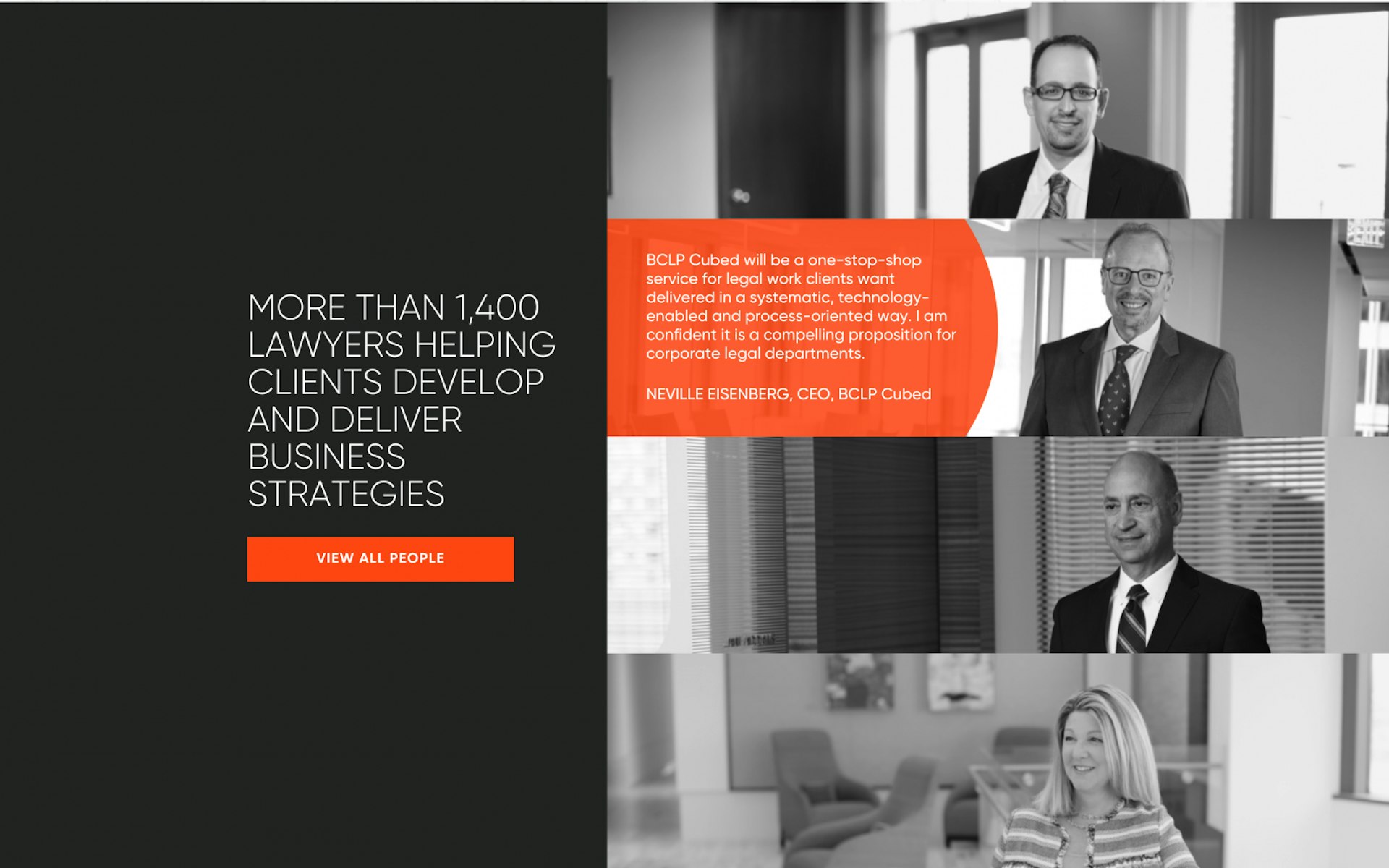
We're a full-service digital agency, which for a law firm means one team for the website, the attorney directory, the search program, and the reporting that connects them. We designed and built the Curtis, Mallet-Prevost, Colt & Mosle site on Craft CMS and have hosted, secured, and upgraded it since its 2019 launch. We helped Wilson Sonsini through a rename and a new brand and gave BCLP a single website after its transatlantic merger. For a global Am Law 100 firm, we cleaned up and built out close to 900 local listings across its offices and attorneys, and for a leading personal injury and mass tort firm, our SEO and paid search teams work side by side on the cases that arrive without anyone searching the firm's name. Design, development, and digital marketing all sit under one roof here.

Law firm marketing teams answer to a whole partnership, with every practice group holding a stake in the homepage. We've spent more than a decade learning to get work through that structure and into production, and then to prove what it did.

Start a conversation

A leading personal injury and mass tort firm asked us to grow the cases it gets from non-branded search, meaning people looking for a lawyer who don't have the firm's name in mind. Comparing this July through September with the same months last year:

63%

more non-branded organic clicks, year over year

52.8 → 14.7

average Google position across the firm's non-branded terms

1.9

average position in AI answers to "top personal injury attorney" prompts in the firm's home state

03 Clients

Some of the firms we've worked with

  • Wilson Sonsini
  • Weil, Gotshal & Manges
  • Winston & Strawn
  • BCLP
  • Faber Law Group
  • Curtis, Mallet-Prevost, Colt & Mosle
  • Kelley Drye & Warren
  • Hughes Hubbard & Reed
  • Fenwick
  • Orrick
  • The Bluebook, published by the Harvard Law Review and three other law reviews

04 One team

You work with the same senior team across all three disciplines.

Curtis has worked with us since 2018. Our design team led its redesign and art-directed the attorney photography. Our developers built the site on Craft (and upgraded it to Craft 5 this year), and our engineers run the AWS environment it sits on. Our SEO and analytics teams have worked on the same property, and we train the firm's marketing staff on the CMS and on Figma when they want to make changes themselves. Nobody new joins the conversation when a question turns from design to infrastructure.

At a law firm, the attorney bio (usually the most visited template on the site) does double duty as a business development page and as the search result for the attorney's own name. Getting it right means solving a design problem and an indexing problem at once. One team that owns both will usually get there faster than two teams trading tickets.

05 Professional conduct

We write to the rules of professional conduct from the first draft.

Start a conversation

Every state regulates lawyer advertising (most by building on ABA Model Rules 7.1 through 7.3), with rules that reach your website, your ads, your directory profiles, and your social posts. Our team writes copy designed to clear your review the first time, with no unverifiable superlatives, no "specialist" or "expert" language unless the attorney holds a certification that permits it, and the disclaimers each state wants around past results. We also build each state's requirements into the launch calendar. New York requires the "Attorney Advertising" label on qualifying communications (a firm's homepage among them) along with a prior-results disclaimer, and Florida and Texas both run formal filing and review for many ads. For multistate firms, we design each template around the strictest jurisdiction its attorneys are admitted in, since one practice page has to satisfy all of them.

Case results and client testimonials still belong on the page, because people choosing a lawyer want evidence that the firm wins. We build the required disclaimer into the case results component itself, where an editor publishing the next verdict can't forget it. On the paid side, Google verifies each attorney's bar license before it will run Local Services Ads under the Google Screened badge, and we manage that verification for you.

Your own website carries legal exposure too. Our analytics team has audited and corrected tag setups for clients who received demand letters under the California Invasion of Privacy Act (CIPA), which keep arriving at company websites from a small group of plaintiff firms and target chat widgets, session replay, and pixels that fire before a visitor consents. The fix usually meant moving hard-coded scripts into the tag manager and making consent actually control what loads.

We treat accessibility as a compliance question too. ADA website suits are filed by the thousands every year, and law firms make awkward defendants. We've corrected WCAG 2.1 AA issues across a Midwest full-service firm's navigation, and we're building a bankruptcy trust administrator's new site to WCAG 2.2 AA from the start. We've treated accessibility as everyone's job on the team for a long time.

06 Paid media

Paid media built around signed cases.

We build legal paid search accounts to keep every dollar pointed at cases the firm will actually take, since a single click on a personal injury or mass tort term can cost well over a hundred dollars. For a personal injury or mass tort practice, our team sets up a separate campaign and budget for each tort, call-only and call-focused ads on mobile, Local Services Ads, geography drawn to where the firm can practice, and invalid-click filtering. On one firm's account, the filter flagged 83% of a new tort campaign's clicks as invalid in its first weeks, and Google credited the spend back.

Larger firms rarely buy client relationships one click at a time. Their paid programs lean toward LinkedIn and programmatic campaigns for partner thought leadership, practice launches, and lateral recruiting, with search reserved for the practices where the firm does take direct inbound matters.

A worked example

When we reviewed a leading personal injury and mass tort firm's Google Ads account this year, it was running 14 campaigns and 39 ad groups, including three dormant medical malpractice campaigns. We rebuilt it as nine campaigns. Each of the seven active mass torts kept its own campaign and budget, since every tort has its own intake criteria, its own case value, and its own window before the docket fills. The four personal injury campaigns became one campaign with ten ad groups, so budget can follow demand across case types. The dormant medical malpractice campaigns became a single campaign with seven ad groups, ready to switch back on. We also moved the account toward exact match, which reduces the chance of an ad appearing against a search for a competing firm by name.

We run Google, Microsoft, LinkedIn, Meta, Yahoo DSP, and Simpli.fi, and we're candid about which ones don't earn a place in a given plan. Microsoft Advertising deserves more attention in legal than it usually gets, since it often reaches the same intent at a lower cost per click. Most of what Lee Goldberg, our co-founder, wrote about lead generation for law firms in 2019 still holds.

  • Google Ads
  • Microsoft Advertising
  • LinkedIn Ads
  • Meta
  • Yahoo DSP
  • Simpli.fi

07 Mass tort

Mass tort marketing runs on the docket's calendar.

A tort's acquisition window usually opens with a recall, an FDA safety communication, or a published study, then narrows once national firms have signed most of the claimants and the cases are consolidated into multidistrict litigation (MDL). Our team sizes each opportunity before the firm spends on it. One firm's NAION campaign (a form of vision loss linked in litigation to GLP-1 drugs) had roughly 10,000 searches a month nationally behind it, while searches pairing Dupixent with cutaneous T-cell lymphoma ran under 400. Those two numbers call for different budgets, and for different answers to whether search alone can carry a tort or whether it needs paid social behind it.

We also study how the national mass tort firms buy media before recommending a plan. A recent teardown of two of them covered more than a hundred live Facebook and Instagram ads and showed more than half of one firm's social spend going to video, which told our client roughly where the floor for creative investment sits.

Tort-level search

Separate campaigns, budgets, and intake criteria for each tort, so a high-value case type never runs out of budget because a cheaper one spent it.

Call-first ads

Call-only and call-asset ads on mobile, with short calls excluded from conversion counts so the account optimizes toward real conversations.

Local Services Ads

Google Screened listings billed per lead, with disputes filed on leads that don't qualify.

Paid social by state

Meta campaigns limited to the states where a tort's claimants live and where the firm can take the case.

Programmatic and CTV

Display, online video, and connected TV once the firm has video worth running, with audience data layered over it.

Careful retargeting

Retargeting written so it never implies we know someone's diagnosis, which Meta's personal attributes policy requires and which prospective clients notice.

Competitive intelligence

Ad library teardowns of national firms' creative, spend mix, and landing pages before we commit a budget.

Intake-ready landing pages

One page per tort, written to answer the qualifying questions intake will ask, with the phone number in reach on every screen.

08 Measurement

Most legal leads arrive as phone calls that many firms never count.

Bidding optimizes toward signed cases

01

Click

02

Call or form, with the click ID attached

03

Intake

04

Signed case

05

Back into the ad platforms

In our experience, most of the conversions a law firm website produces end in a phone call that never shows up in the reports deciding next quarter's budget. Our team tracks those calls through CallRail and the ad platforms' own call tracking, sets a minimum call duration so wrong numbers and solicitations don't count as leads, and carries the click ID through to intake. When the intake team signs a case, that outcome goes back to Google and Microsoft so bidding learns from signed cases. We've written up the method in detail.

Sometimes the problem sits upstream of all of that. One firm's GA4 property couldn't connect paid traffic to outcomes because its click-fraud tool was stripping Google's click identifier from landing page URLs, so every paid visit lost its source the moment it arrived. Our analytics team traced the cause and fixed it, and the attribution came back.

Our analytics team owns the layer underneath: GA4, Google Tag Manager, consent management, and audits of what a firm already has installed (we've run them for Curtis and for other firms). Measuring accurately without third-party cookies is its own discipline now, and we keep a current playbook on it.

Start a conversation

09 SEO and AI search

Your next client may ask an assistant which lawyer to call.

For consumer practices, that question is often close to literal ("who's the best car accident lawyer near me?"), and assistants assemble the answer from directories, reviews, and the firm's own practice pages. We measure where a firm shows up in those answers. For a leading personal injury and mass tort firm, our SEO team built a set of prompts that mirror how prospects actually ask, and the firm now averages a position of 1.9 in AI answers to "top personal injury attorney" prompts in its home state. Over the same period, its non-branded organic clicks rose 63% year over year, "car accident lawyer" moved from position 67 to 7.5, and a core medical malpractice term moved from 18 to 7.6. Our team got there by rewriting practice pages and blog content so assistants could cite them, restructuring the firm's mass tort pages, and cleaning up its Justia and directory profiles. Our position is that SEO is no longer enough on its own.

Corporate firms face a different version of the same problem. A general counsel who hears your name from a colleague will search the partner, ask an assistant what the firm is known for, and read whatever comes back. We'll tell you plainly when search isn't a meaningful source of new matters for your firm (at many large firms it isn't), and then put the work where it pays off: attorney bios that rank for the attorney's own name, practice and industry pages that answer the questions a GC actually asks, and Insights content structured so assistants can cite it. When a new antitrust boutique's attorneys weren't showing up in searches for their own names, our audit traced the problem to how the bio pages were indexed and how the Insights archive was organized.

Local visibility still matters at every size. For a global Am Law 100 firm, we corrected roughly 300 existing Google Business Profiles and built the rest, close to 900 listings across offices and attorneys, and then set up the process that keeps them current as attorneys join and leave. Monthly organic traffic grew by more than 100% after the listings launched.

The rest of our law firm SEO practice covers what you'd expect and should still ask about: entity consistency across attorney, practice, and office pages, structured data for attorneys and legal services, technical crawlability and Core Web Vitals, and a deliberate policy on which AI crawlers you allow.

We'll also recommend publishing client alerts as indexable pages with the PDF offered as a download, since assistants rarely cite a PDF and many firms publish their best thinking in one.

10 Design

A firm's website is read most closely by people who already know its name.

Most visitors to a law firm's website come from a referral, a pitch, or a recruiter's call, checking whether the firm looks the part. Our design work starts with those readers and brings the firm's own people into the process, which at a law firm usually means a marketing team, a managing partner, and a committee with opinions. Our design leadership has written a primer on building trust through design, and the same thinking runs through our wider UX practice.

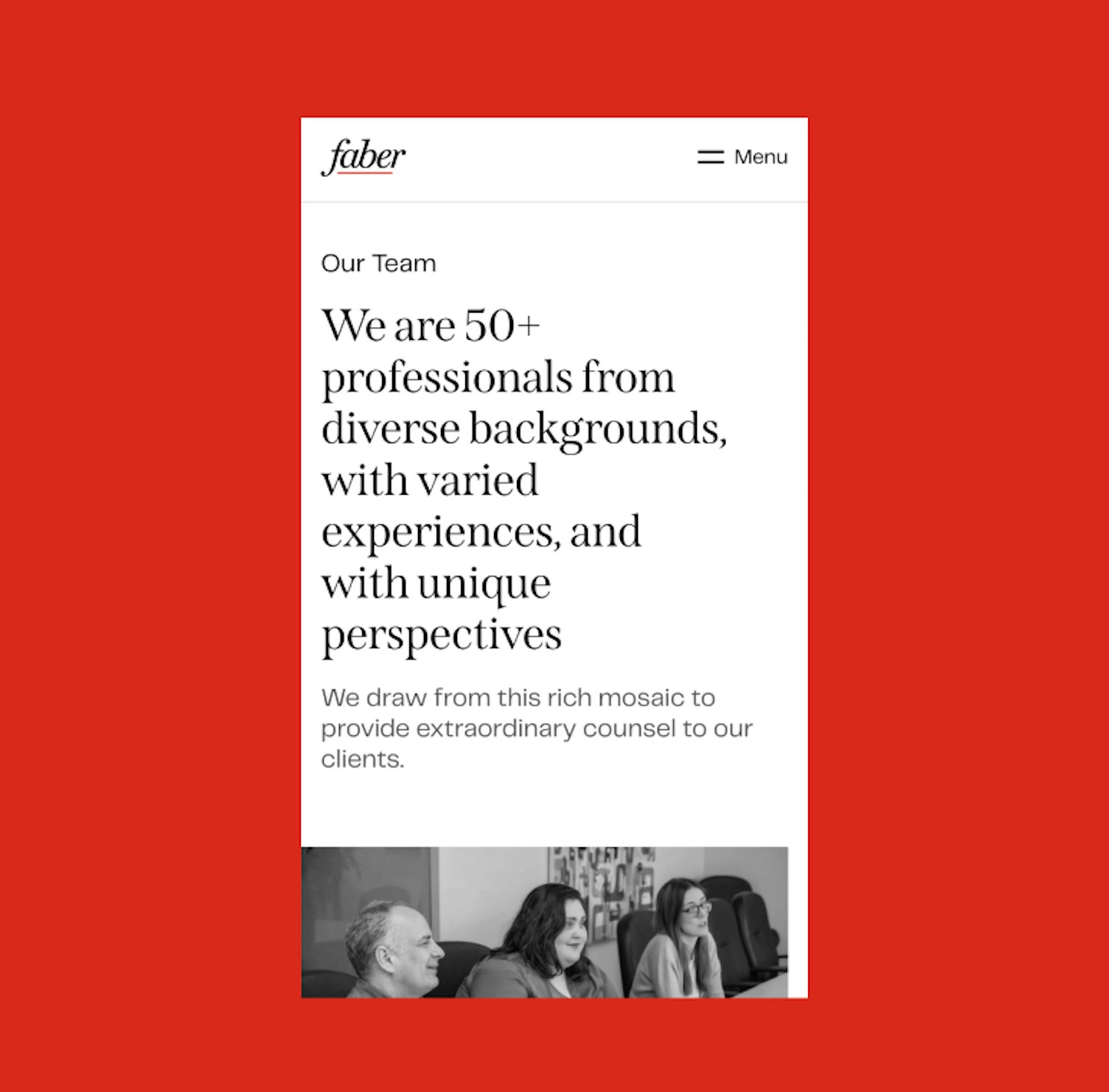
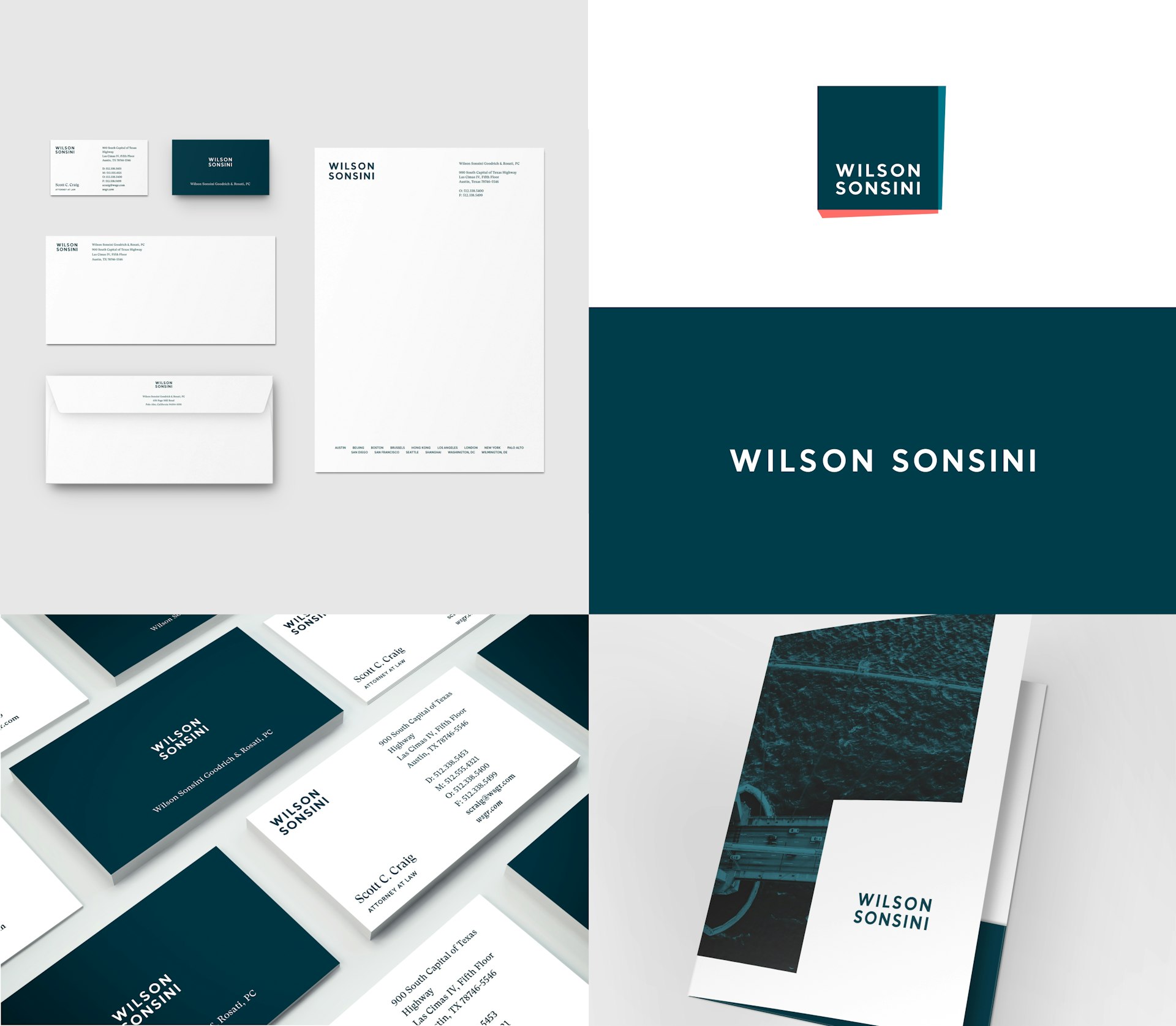
For Wilson Sonsini, discovery interviews and onsite workshops surfaced an internal appetite for a name change, and our team carried that through the brand strategy, a new logo, print collateral, and a site organized by practice, person, and office. For Faber Law Group, we set aside the neoclassical columns in favor of unstaged black-and-white photography of attorneys at work, which kept the focus on the firm's people and let its red stand apart from competitors in blue and gray. Joe Faber told us afterward that the firm had seen "an uptick in credible leads."

Newer firms need the whole identity at once. For Logan Trial Lawyers, our team designed the logo and brand guidelines, the business cards and letterhead, a splash page that went up within weeks, and the full Craft site that followed, built to feel different from a typical lawyer's website.

11 CMS

We build the CMS your marketing team can run on its own.

Craft and WordPress account for most of our law firm work, and the question we care about is what your marketing team can publish on a deadline without filing a ticket. That covers attorney directories with bios, vCards, PDF bios, and bar admissions; practice, industry, and office taxonomies that let a visitor find the right person from any direction; Insights and client alerts that flow into the firm's email platform (we integrated Vuture for one Am Law firm); Algolia-powered search across people and content; and editorial workflow with approval steps that match how your firm actually signs off. If you're still choosing a platform, we've written down the eight questions that actually decide it.

We're comfortable inside platforms we didn't choose, too. For BCLP, our designers worked with RubensteinTech so the new designs would function inside the RubyLaw platform, and we built a joint landing page that let the merged firm announce itself before the main site launched. For another Am Law firm, we handled the Craft build while an outside agency led design.

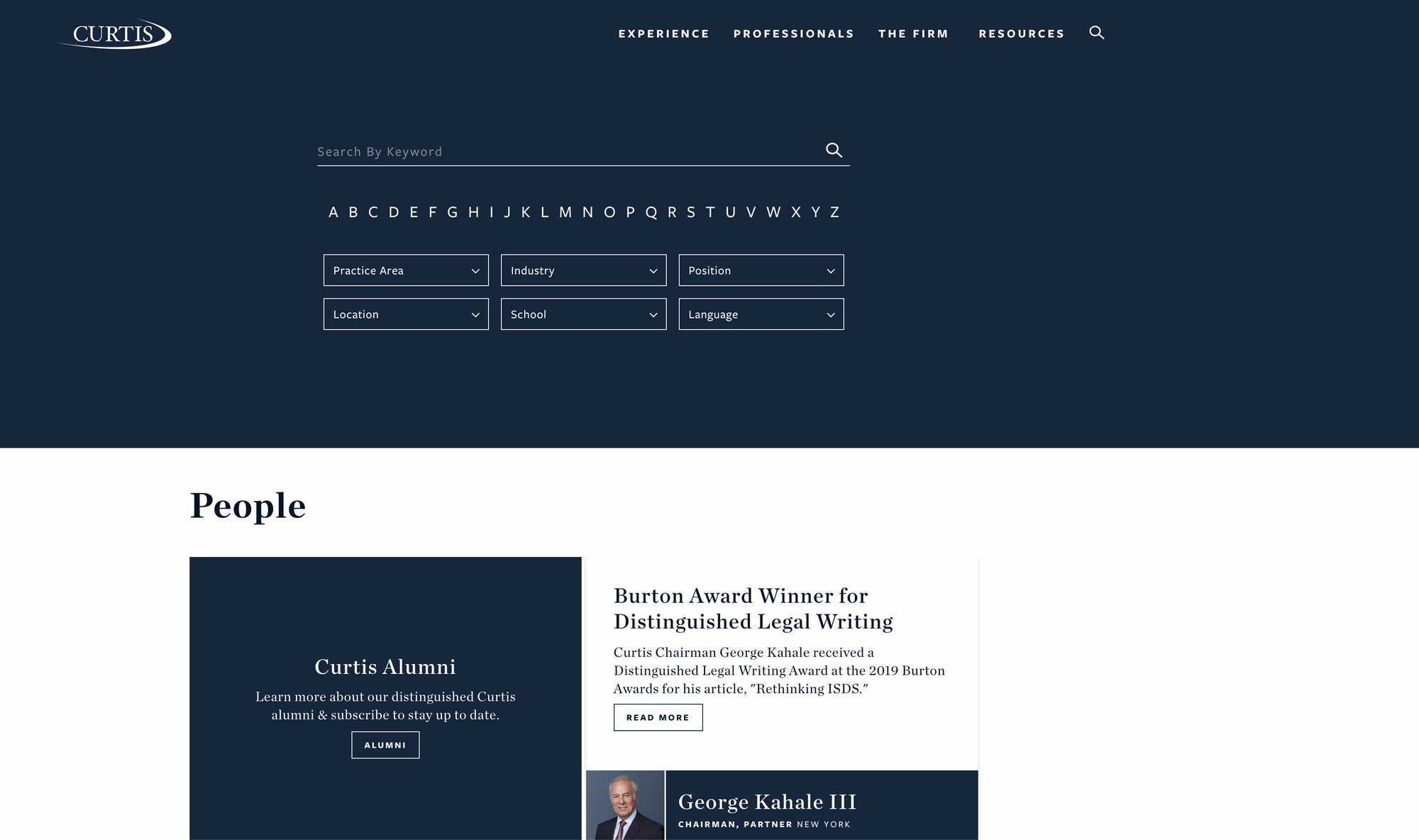
The Curtis attorney directory Happy Cog built on Craft, with keyword search, an A to Z index, and filters for practice area, industry, position, location, school, and language
Curtis attorney directory on Craft
BCLP attorney pages Happy Cog designed to run inside the RubyLaw platform
BCLP on RubyLaw

12 Security and performance

The questions your IT team will ask, answered before they ask them.

Our engineering team plans for the scrutiny a firm's IT team brings, since that team answers to client security audits and outside counsel guidelines. The work covers secure hosting architecture, web application firewall rules, dependency and plugin patching, uptime monitoring, and single sign-on and role-based access for editors. This year we rebuilt the Curtis hosting environment on AWS with load-balanced web servers and a managed database, alongside the move to Craft 5. A Midwest full-service firm gets a written security review from us every quarter, and blocking unverified bots and aggressive SEO crawlers on its site cut bot traffic by 21% and origin bandwidth by 26% over twelve months. Our written reviews state exactly what we checked and where the review's limits were, the way a firm's general counsel would want them written.

We also test launches from inside firm networks, since many firms run SSL inspection proxies that can break a page nobody outside the building sees broken.

Modernizing a site the previous vendor left behind, without a full rewrite, is a specialty of ours.

13 Recruiting

Recruiting is its own audience with its own pages.

Start a conversation

Law students, laterals, and staff read a firm's site differently from clients, comparing it against every other firm on their list. This year our team redesigned a Midwest full-service firm's careers section (seven pages on two new templates, commissioned by the firm's legal recruiting team) and launched it alongside a new navigation and rebuilt Insights and News archives. Recruiting was one of the audiences we designed for at Weil, Gotshal & Manges, where the site puts the firm's people and culture up front.

On the paid side, LinkedIn is usually where lateral recruiting budgets belong, with campaigns targeted by practice, seniority, and current firm.

14 Coverage

The parts of the profession we know

Global and Am Law firms.

Rebrands, mergers, redesigns, attorney directories, hosting, and local search at a scale of hundreds of offices and attorneys. Wilson Sonsini, Weil, BCLP, and Curtis all sit here, along with several other Am Law 100 and Am Law 200 firms.

Regional and full-service firms.

Firms that compete with national players in their markets and need a site, a search program, and a support retainer that one marketing team can manage. We support a Midwest full-service firm's site on retainer, and we redesigned Faber Law Group on Craft.

Litigation and specialty boutiques.

Newer and smaller firms, where the website often carries more of the firm's credibility than it would at a larger one. We're redesigning a national antitrust boutique's site now, after starting with an SEO audit, and we built the brand and site for Logan Trial Lawyers.

Personal injury, medical malpractice, and mass tort.

High-cost search, call-driven intake, tort-by-tort budgeting, and SEO and AI visibility tracked against the questions injured people actually ask. Our longest relationship here is with a leading personal injury and mass tort firm whose paid search, organic search, and AI visibility we manage together.

Legal publishing and reference.

We redesigned The Bluebook for the four law reviews that maintain it, including its subscription platform and its predictive rule search.

Lawyer-owned insurance and fiduciary services.

We support a lawyer-owned mutual insurer's site on Craft, and we're redesigning the site for a bankruptcy trust administrator affiliated with an Am Law firm.

Adjacent categories we know well include financial services and B2B, both of which share the long consideration cycles and review-heavy approvals of law.

15 Case studies

Selected work

Curtis, Mallet-Prevost, Colt & Mosle

Curtis, an international firm with offices across the Americas, Europe, the Middle East, and Asia, hired us in 2018 to redesign its website. Our team designed the site, directed the attorney photography, and built it on Craft CMS with Algolia-powered search across people and practices, then planned the URL migration and redirects to protect the firm's existing search visibility when it launched in 2019. We've hosted and supported the site ever since. This year our engineers rebuilt its AWS environment and moved it to Craft 5. Our support retainer covers maintenance, automated QA, security monitoring, and CMS training for the firm's marketing staff.

A global Am Law 100 firm

The firm had roughly 300 Google Business Profiles across its offices and attorneys, many of them out of date or in conflict with each other, and hundreds more locations with no listing at all. Our team corrected the existing profiles, built the remaining listings for close to 900 in total, optimized each one, and set up a process to keep them current as attorneys join and leave and offices open or close. Monthly organic traffic grew by more than 100% after launch.

A leading personal injury and mass tort firm

Our paid media and SEO teams work on this firm's account together. This year we restructured its Google Ads account from 14 campaigns to nine, giving each active mass tort its own budget and consolidating personal injury and medical malpractice so spend can follow demand. On the organic side, we rewrote practice pages for AI citation, restructured the mass tort content, and optimized its directory profiles. Non-branded organic clicks rose 63% year over year, the firm's average position on non-branded terms improved from 52.8 to 14.7, and it now averages 1.9 in AI answers to "top personal injury attorney" prompts in its home state.

Logan Trial Lawyers

Logan Trial Lawyers came to us as a new firm that needed a brand, printed materials, and a website that would work for both injured clients and the referring attorneys who bring it cases. Our team designed the identity and brand guidelines, the business cards and letterhead, a splash page that went live within weeks, and the full site on Craft CMS, which launched in early 2026.

See more of our law work

16 FAQ

Common questions

Do you know the attorney advertising rules in our states?

Yes, and we'd rather plan around them in the first week than discover them in review. We write copy that avoids the claims bars restrict most often (superlatives, unearned "specialist" language, and results without disclaimers), and we build state filing and review requirements, like Florida's and Texas's, into the launch calendar. Your ethics or general counsel's office still has the final word. We want them to see material they can approve on the first pass.

How do you work with a marketing committee and dozens of partners?

Carefully, and with a plan for it. We'll ask early who signs off on what, design the review steps into the project schedule, and give practice group leaders a way to weigh in on their own pages without reopening the homepage. A lot of our law firm work has involved exactly this, including discovery interviews and onsite workshops with partners before any design starts.

Can you show which campaigns produced signed cases?

Yes, and it's one of the main reasons firms hire us. We track calls as well as forms, set a minimum call length so junk doesn't count, carry the click ID into intake, and send signed cases back to the ad platforms so bidding learns from them. You'll see reporting at the level of the individual lead, the level your intake director works at. There's a longer explanation of how it works here.

Can you take over our site from our current vendor?

Yes. Our work with one Midwest full-service firm started that way: we took over its WordPress site from the previous developer and kept it running through the transition. We work in Craft and WordPress every day and have designed for legal platforms like RubyLaw, so a short audit will usually tell us whether your platform should stay.

Can you launch a mass tort campaign quickly?

Usually within days once the firm decides to pursue a tort, because most of the work (search sizing, keyword lists, landing page structure, call tracking) follows a pattern we've run many times. What takes longer is creative for paid social and video, so if a tort is likely to need more than search, tell us early.

Who's actually on the account?

Senior people, and the same ones over time. Our co-founder leads the digital marketing practice and is personally involved in our law firm accounts. There's no model here where partners pitch the work and juniors deliver it.

17 Start a conversation

Tell us what you're trying to move this year.

Whether it's a redesign your partners will sign off on, a paid program that fills your intake calendar with cases you'll take, or showing up when a prospect asks an assistant which lawyer to call, we'd like to hear about it. A first conversation is just that.

Tell us what you're solving for.

Loading form…

We'll reply within one business day. No sales sequence, no spam.